§ Maurice Ravel — 1919-1925, M. 71
L'Enfant
et les sortilèges
Lyrical fantasy in two parts — Ravel / Colette (1919-1925)
A new revised edition prepared under the editorial direction of François Dru, presented in two forms: orchestral material and a published Vocal & Piano score with musicological texts and illustrations.
European premiere
26 September 2025 — Alte Oper, Frankfurt
Hr-Sinfonieorchester, NFM Choir, Kinderchor der Oper Frankfurt · Alain Altinoglu
North American premiere
3 October 2025 — Jacobs Music Center, San Diego
San Diego Symphony Orchestra, Symphony Chorus, Children's Choir · Rafael Payare
Editorial direction
François Dru
Reading committee
Editorial direction
Revised edition under the editorial direction of François Dru.
Reading committee

Conductor
Alain Altinoglu

Conductor
Rafael Payare

Chief librarian
Courtney Cohen
San Diego Symphony Orchestra
With the invaluable collaboration of the librarians of the Hr-Sinfonieorchester.
Editorial note
The orchestration of L'Enfant et les sortilèges: a large orchestra in miniatures
By François Dru — editorial director of the Ravel Edition
While the composition of the vocal score of Ravel's second opera unfolded over a long period, the orchestration of L'Enfant et les sortilèges belongs firmly to the short term and the pressure of the very last minute. We have previously discussed the dates 1920 to 19251 written in the composer's hand on the final bar of the autograph score held at the Morgan Library & Museum2. As for the only orchestral manuscript3, and unusually for a composer who generally added his signature and a date of completion or period of work, nothing appears after the final double bar. This absence matches the empty bars on the chorus staves and the Child's final call, left blank on a document apparently completed in great haste4 — as does the nervous handwriting visible in the crossings-out of the very last bars of the two solo violins, which in a first idea went on doubling the oboes to the end.
The stormy correspondence between the management of the Monte-Carlo Opera and Serge Diaghilev, director of the theatre's ballet, tells us that the preparation of the premiere — amid the impossibility of preparing the choreography and dancers in time, threats to break the contract, a lawyer's visit and a brawl between Ravel and Diaghilev in the lobby of the Hôtel de Paris — took place in a climate quite unlike the reassuring garden of the Child imagined by Colette. Having earlier asked to receive a score by 1 November 1924 so that Balanchine could build the many dance numbers of this comédie-ballet, the Russian impresario complained a week before the premiere, in his letter of 15 March5: “(…) In fact, I could not obtain most of these scores before January and February 1925”. He added, to René Léon, managing director: “At the beginning of March, that is a few days ago, the director of the Monte-Carlo Opera sent us the score of M. Ravel's new opera, which was to be given on the 19th of this month”. A few days earlier, on the 13th, again in a letter of complaint to Raoul Gunsbourg, he had pronounced the score “(…) too difficult”6.
Turning to Ravel's published correspondence7: a week before the premiere, on 15 March, he wrote to Colette, who had not yet arrived in the Principality, describing all the difficulties of the rehearsals caused by “(…) the disastrous state of the material”, yet saved by “(…) a superior orchestra and a truly extraordinary conductor”. To his publisher Jacques Durand he reported: “(…) I was taken up by rehearsals and also, alas! by corrections – a mistake in every note – thanks to a wonderful orchestra, which loves the work, and a conductor such as I had never met, it all sorted itself out in the end (…)”.
Arbie Orenstein8, presenting the correspondence between Maurice Ravel and Lucien Garban in 2004, introduced the only two surviving documents on the progress of the orchestration and the preparation of the engraving. On 10 February 1925, Ravel wrote to Durand's artistic director:
“(…) Here, at least, is the end of the first tableau. I think I forgot to mark sul ponticello for the solo first and second violins and viola that open the second tableau, and perhaps also div. for the tutti. Yet I cannot abandon my orchestration to correct the transcription9, which still has many mistakes, alas! Can't the printing be postponed by a few days? (…)”
Six weeks before the premiere of his new work, Ravel had only finished orchestrating the first part. No fewer than eighty pages remained — and not the least of them, those containing the orchestra's real and rare tutti. Not to mention the copying out of the parts by one or more copyists for a fifty-minute score. Beyond the long-standing grudge between Diaghilev and Ravel since Daphnis et Chloé was performed without chorus in 1914, or the aftermath of the Ballets Russes director's curt refusal in 1920 to present La Valse — also composed against the clock — in his next season, it is easy to understand how waiting for a complete score and its parts could cause some anxiety in the production team.
It should be added that, although to our knowledge the start of the orchestration cannot be precisely dated, Ravel, as was his habit, already had the colours of his opera in mind — as confirmed by a musical autograph, in the form of a dedication, to his London friends Charles Harding and Louise Alvar, dated 20 October 1923, with the first two bars and the marking “Hautb[ois]” over the melodic line in fourths and fifths10. In Le Figaro of 20 March 192511, the journalist André Arnoux, who had attended a rehearsal with orchestra and chorus but without scenery, talked with the composer about his new score. He quotes Ravel: “(…) Above all I must express my warm admiration for the conductor, M. Victor de Sabata. Twelve hours after receiving my score, he knew it by heart. But he is himself a composer of great talent, and it is the best fortune in the world to see the baton in the hands of a musician who — to speak like a soldier — is an ace, and who conducts, like a great master, the finest orchestra one could wish for (…)”.
Sabata, then the resident conductor in Monaco and aged 32, was certainly the saviour of this last-minute operation, and the composer publicly expressed his gratitude. The day after the premiere, Ravel sent him a short letter:
“(…) Dear friend. I did not tell you enough during the rehearsals — those terrible rehearsals in which we all had to act as proofreaders, and during which, I assure you, I suffered no less than you — I did not tell you enough how touched I was by the high artistic conscience that you, a prodigious conductor, and your orchestra of virtuosos brought to the realisation of so difficult a work. You have given me one of the most complete joys of my career, and I thank you all, from the bottom of my heart, for my success last night. Believe me, dear friend, your devoted Maurice Ravel”12
All the more so since the Italian conductor almost certainly had to conduct from the composer's manuscript, which — given its mistakes, gaps, crossings-out and second thoughts — was no small feat, especially with so little preparation time. This direct confrontation also allowed, from the very first contact, a substantial round of corrections and editorial questions that eased the preparation of the engraving at Durand under Lucien Garban. It should be remembered that the full score and the orchestral parts were not available from Durand until October and November 1925 respectively, in view of the revival and French premiere at the Salle Favart in early 1926.
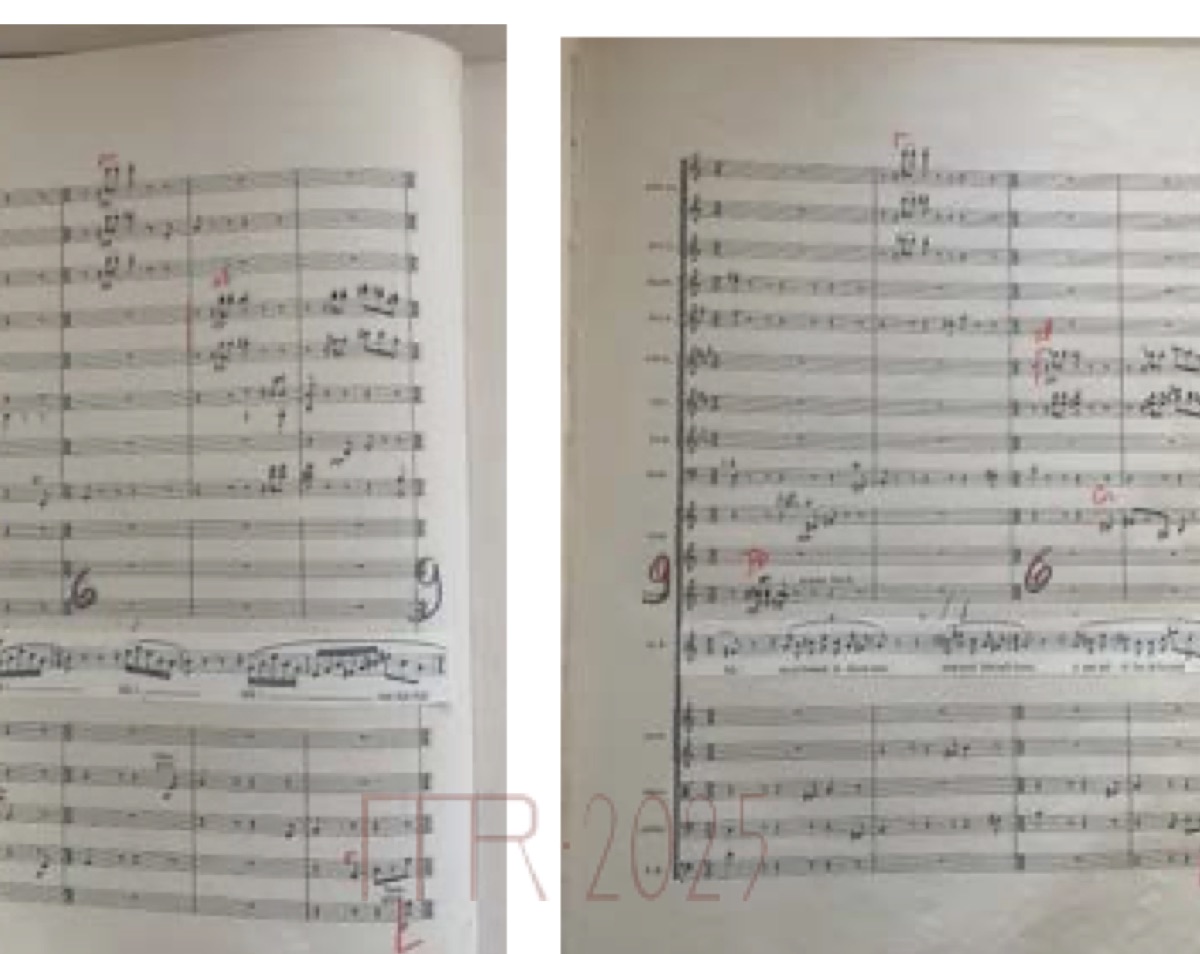
Unfortunately, as is the fate of so-called temporary material, absolutely nothing remains of the handwritten scores and parts used in Monaco in 1925. Nor is there a printed score in the Sabata collection — a bitter loss for anyone trying to understand the editorial problems that persisted after Durand's first publication, and any annotations by the conductor of the premiere13. Notes and queries can however be found on Ravel's manuscript, which bears several hands besides the composer's: that of Lucien Garban, now familiar to us through our work, who always added the metronome markings in pencil, and others — hard to identify with certainty — in conductor's blue pencil or in black and red ink, which added Colette's text, as in the Ragtime scene of the Teapot and the Cup, for which Ravel wrote almost no words; as well as corrections of accidentals, added rehearsal figures, and so on.
It is this same “American” scene whose corrections and changes appear in the only surviving letter between Ravel and Garban written while preparing the engraving, first presented by Arbie Orenstein in 2004. While the great Ravel specialist faithfully reports Garban's hesitant handwritten dating of this undated letter14: [1923-24?], we think it more likely, from the details it contains, that Ravel wrote it while orchestrating, in spring 1925 or in the months after the premiere, when he returned to his manuscript for the engraving: “(…) Here is the Rag. If every scene gave me this much bother, I'd finish next year (…)”. Ravel refers here to the page numbers of the manuscript and gives as his first instruction: “1° I leave it to you to add the text and the tempos, which are not on my manuscript (…)”. The notes end: “All this will be less serious than bars forgotten, or too many (…)”.
As a postscript there is a most original note, with a drawing by the composer to illustrate his description: “(…) Page 44, the red + [cross] stands for that little box struck with a stick, which makes a huge racket and whose name I don't know. Would you find out its name (from a jazz dealer, for example) and write it in? The same for the guirro, which is a sort of cheese grater, and which may not be known in France and America under that name. It is made like this: [drawing] (…)”. Indeed, the word “Wood-Block” — making its first appearance in Ravel's percussion section, to return in both Concertos — was added to the manuscript in pencil by Lucien Garban. It would have been fascinating to find the very first handwritten percussion part to see what was asked of the Monaco players. Likewise the “Guirro” of the Cuban dance bands so loved by the composer, requested by Ravel but removed from the instrument list of the Durand score at the end of 1925, became a “Râpe à fromage” (cheese grater) — or how wood turned into metal.
Finally, to conclude on the percussion, the slide whistle, played from the pit, that precedes the chorus of shepherds and shepherdesses was originally called a “flûte à eau” (water flute) by Ravel. The “Livre de bois” (wooden book), supposedly played by the tenor during his arithmetic number, is in fact the clapper used by primary-school teachers to drill their pupils. As for the tam-tam at figure 15, if the quavers have surprised many conductors, one should remember the much smaller instruments used in the early 20th century to grasp how playable the writing was.
So while nothing survives of the musical material of the Monaco premiere — except the precious orchestral manuscript, which finally returned to Monaco through a gift to the Prince's Palace by Jean-Jacques Lemoine, former head of legal affairs at Durand and owner of the manuscript —, we know that for the revival and Paris premiere at the Salle Favart15, and the simultaneous Belgian premiere16 at La Monnaie in Brussels, the full score and parts engraved by Durand were used. This first printed version still contains the first form of the Fire's vocal line, which was changed after the February 1926 performances and became, in a new printing, the “new, higher version”, when the three coloratura roles were merged into a single singer17, unlike the original Monaco production with one singer per role. The library of the Paris Opéra (BMO), which holds the Favart collection, preserves the different versions of the score, and the orchestral library of Radio France still owns a full score that almost certainly belonged to Manuel Rosenthal, showing all the paste-overs needed to change the Fire's aria.
The four stops of the luthéal, which change the sound to imitate a harpsichord or a lute — called “Piano” by the composer on his manuscript — are clearly marked by Ravel, who does not propose the ossia, engraved by Durand, of a piano prepared with sheets of paper18. The red-ink corrections in the manuscript were carried over into the Durand edition, such as octave changes in the bass clarinet, simplified and corrected key signatures in bitonal passages19, and corrections of transposition errors in the E-flat clarinet or horns. Conversely, comparing the first engraving with the manuscript annotated by Ravel, Sabata and Durand's editorial team, some changes were made without any pencil note in the manuscript — for instance the change of orchestration in the bassoons and horns (the hissing trills) at the end of the Clock's aria. We have chosen to restore this original orchestration in our centenary edition (indicated by the editorial code [ ]).
Although several “historical” sets of parts we consulted show a surprising change of solo string instrument in the introduction — given to the solo double bass in harmonics, imitating the erhu, which seemed hard to play in 1925 and was given as an ossia to a solo cello at the Paris Opéra or the Orchestre National —, we have of course kept Ravel's original intention as written in his manuscript. Likewise, in the lower strings, we decided not to alter the “famous” double-bass divisi before figure 73, which at that point requires no fewer than seven players — a number Ravel certainly never had20 and which all performers still simplify today. For the same section, at figure 27, we have flagged the very late addition at Durand of a double-bass staff, whereas Ravel had initially chosen not to use them.
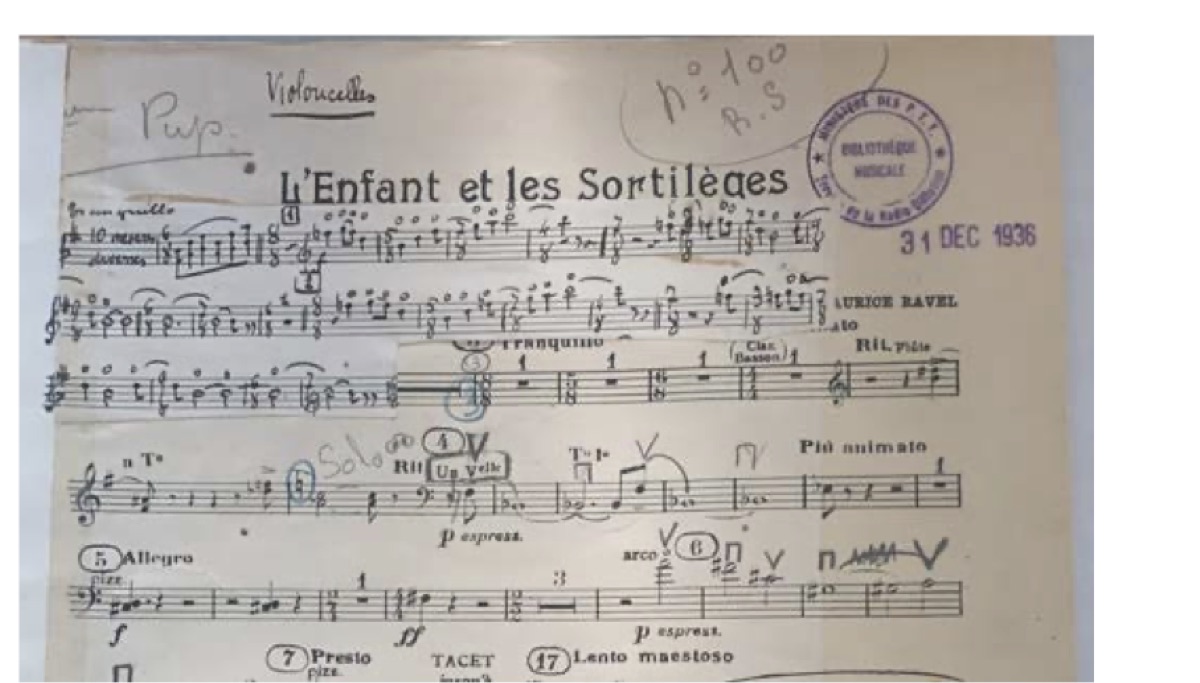
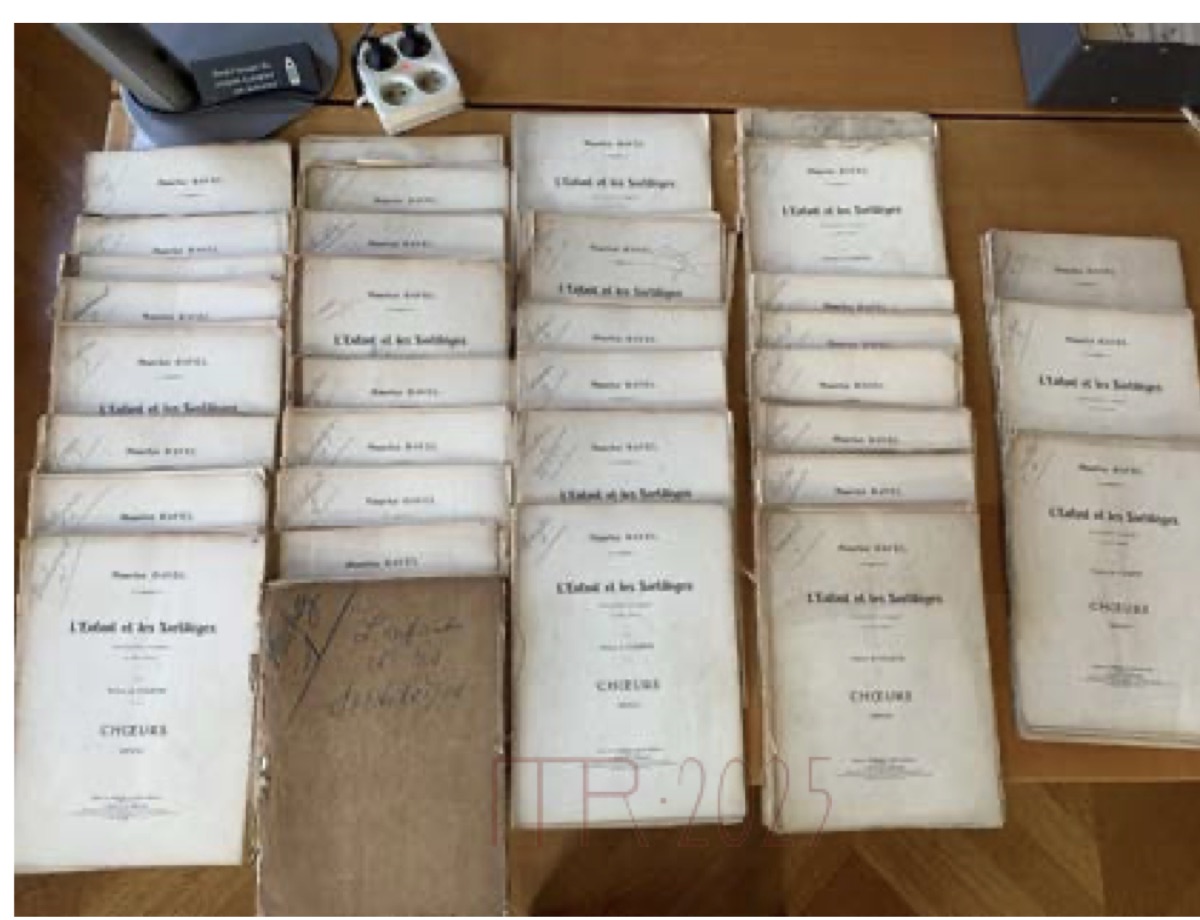
As already mentioned, Radio France still owns a moving and precious complete set of parts, heavily used judging by the state of the paper, which on entering the library of the first orchestra of French public radio received an official stamp of the “Ministère des P.T.T. – Service de la Radiodiffusion – Bibliothèque musicale” and, above all, the date “31 December 1936”. This material, which includes corrections and changes of instrumentation to the 1925 Durand parts, was almost certainly first used in the deeply emotional concert broadcast live at 8.30 pm on “Paris P.T.T.” on the very evening of Ravel's death, 28 December 193721 — a moving musical vigil conducted by the faithful Manuel Rosenthal, with a radio “foreword” by Colette, in the presence of Igor Stravinsky, the long-time companion of the Ballets Russes years, to whom Ravel had paid tribute by quoting, deliberately or not, the introduction of his Nightingale of 191322.
Critical apparatus
Notes
- See Notes on the revised edition, vocal score, Ravel Edition Vol. XI(a), 2024.
- L'Enfant et les sortilèges / vocal score, R252.E56, manuscript, Robert Owen Lehman Collection, The Morgan Library & Museum, New York. The manuscript then belonged to Roland-Manuel, who sold it in the mid-1960s to R.O. Lehman, according to Doda Conrad, then administrator of the Robert Owen Lehman Foundation (see Doda Conrad, Dodascalies, Ma chronique du XXe siècle, Actes Sud, Arles, 1997).
- Archives of the Prince's Palace of Monaco.
- The orchestral manuscript consists of successive gatherings of different sizes: the first, pages 1 to 84, on 30-stave paper; the second, pages 85 to 100, on 32-stave paper. Loose 30-stave pages (101 to 104) are inserted at the start of the Cats' duet. Then 32 staves (105–106), 30 staves (107–118), 32 (119–122), 30 (123–152), and 24-stave paper marked at the bottom “DURAND & Cie 4, Place de la Madeleine, PARIS.” from page 153 (the Animals' scene, “il a pansé la plaie”), alternating with 30 and 32 staves to the end.
- SBM Archives, Monaco. See Paul Druihle, “L'Enfant et les sortilèges de Maurice Ravel”, Les Annales monégasques no. 9, 1985, pages 7–26, Monaco.
- The stormy climate persisted after the premiere. On 27 March, Raoul Gunsbourg wrote to his managing director: “You are aware of the great difficulties I faced during the rehearsals of RAVEL's work, which were only temporarily resolved, for yesterday in the first act of this work five of the ten dancers due to dance the little Louis XV ballet (shepherds and shepherdesses) were missing.” SBM Archives, Monaco.
- Arbie Orenstein, “L'Enfant et les sortilèges : correspondance inédite de Ravel et Colette”, Revue de musicologie, 1966, vol. 52, no. 2, Paris, pages 215–220.
- Arbie Orenstein, “La correspondance de Maurice Ravel à Lucien Roger Garban. Deuxième partie (1919-1934)”, Cahiers Ravel no. 8, Séguier, Paris, 2004, pages 9–89.
- The Durand vocal score (D.&F. 10699), published in March 1925 (deposited on 21 March 1925).
- Freely available on the Morgan Library & Museum website: 115516v_0001.jpg.
- The premiere finally took place on 21 March 1925, the day of the “Fête de la Bienfaisance de la Colonie française” in Monaco. On 21 March, in Le Siècle, André Cœuroy mentioned attending a dress rehearsal with piano, without orchestra.
- Teodoro Celli, L'Arte di Victor de Sabata, Musica e Musicisti, ERI, Turin, 1978, pages 35–37, where the original letter is reproduced in a photograph.
- The scores used by Albert Wolff for the 1926 French premiere, or by Arturo Toscanini for the aborted 1926 Italian premiere at La Scala, if they survive, have yet to be located. Note — contrary to what several books state — that the Italian premiere of L'Enfant et les sortilèges, after the cancelled Milan premiere of spring 1926 (see Ravel's letter to R. Casadesus of 20 March 1926: “(…) And I shall soon have to go to Milan for the final rehearsals of l'Enfant et les sortilèges (…)”), which remains to be documented, finally took place in Florence in 1939 under Fernando Previtali, and not, as usually stated, under Sabata in Milan after the Second World War.
- Op. cit., page 61.
- On 4 February 1926, paired with Rossini's The Barber of Seville, conducted by Albert Wolff.
- On 11 February 1926, conducted by Léon Molle.
- Germaine Féraldy (1894–1946).
- To our knowledge, apart from the Brussels performances in February 1926, we have found no press account of a luthéal in the pit at the Monaco and Paris premieres… A little-documented subject, currently being studied by our colleague Elisabeth Salverda in her thesis on the history of the instrument.
- On page 43, Lucien Garban pencilled this warning for the engravers: “Careful! Some instruments have 1 flat in the key signature, others have 7 (not counting the transposing instruments).”
- See the annex below.
- According to the press, the concert was also broadcast live on the Paris, Grenoble, Marseille and Lille stations (and relayed by several European radios). L'Enfant et les sortilèges was preceded by Georges Hüe's Riquet à la houppe.
- Unless it was Stravinsky who drew on Ravel's sketches for La Cloche engloutie, an opera Ravel was working on before the First World War and later abandoned. See Roland-Manuel, Maurice Ravel et son œuvre dramatique, Les éditions musicales de la Librairie de France, Paris, 1928; Arbie Orenstein, “Ravel: Unpublished Music and Letters”, The Music Forum vol. III, Columbia University Press, New York, 1980.
Annex
The orchestra of the Paris premiere
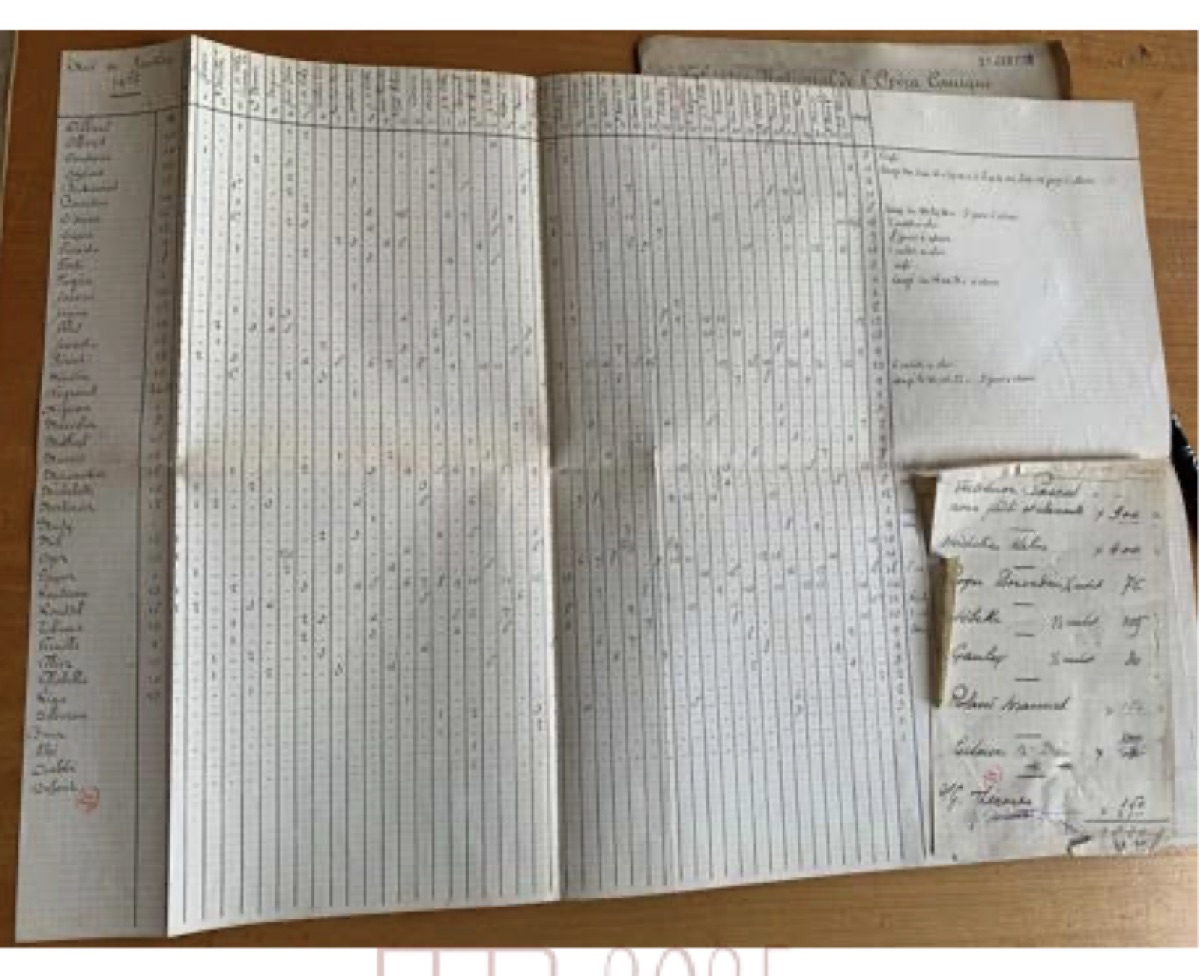
Orchestra of the Opéra-Comique, Paris, 1 February 1926, for the French premiere (La Presse, 24 February 1926):
Flutes: Dortré – Balleron – Maneuvrier · Oboes: Mondain – Gundstoelt – Baloul · Clarinets: Guyol – Perrier – Delacroix – Pigassou · Bassoons: Hermans – Dhérin – Quentin · Horns: Lambert – Massart – Massardo – Coyaux · Trumpets: Lafosse – Brugière – Carrière · Trombones: Hudier – Vigoureux – Delbos · Tuba: Ribier · Timpani: Baggers · Percussion: Auvray – Clayette · Piano: Théroine · Harp: Brug-Hardel
Violins I (9): Mayel – Baudré – Normandin – Berte – Brun – Claveau – Dulaurens – Jacob – Ferret · Violins II (8): Féry – Coudouguan – Monchel – Hamburg – Selmer – Juillard – Gouillard – Boulanger · Violas (6): Ginot – Vizentini – Videix – Paul – Cornet-Francheschi – Barnier · Cellos (5): Laggé – Gerling – Deblauvé – Jamin – Deschene · Double basses (5): Nanny – Juste – Charon – Clément – Darrieux


Available editions
 Orchestral material
Orchestral score + parts
The revised edition for the concert hall and the opera house — full score and complete material available to orchestras.
PS — for hire
For copyright reasons, this revised edition is not available in France, Spain or Mexico.
 Vocal & Piano
Published score — Vocal and Piano reduction
Format 21 × 30.5 cm, hardcover softbound binding. Includes two musicological texts — by François Dru and Arbie Orenstein — and illustrations. Options for pianists and vocal coaches available on request.
Shipping fees depending on the country of destination — please contact us.
Contact